

Cooling‑off vs Self‑Exclusion Key Takeaways
Choosing between a short cooling‑off vs self‑exclusion period can feel confusing, but it really comes down to how much time you need to regain control.
- Cooling‑off vs self‑exclusion lengths differ: hours/weeks versus months/years.
- Cooling‑off is great for impulse resets, while self‑exclusion blocks access for longer-term recovery.
- Think about your past behavior and future plans before deciding which tool fits best.
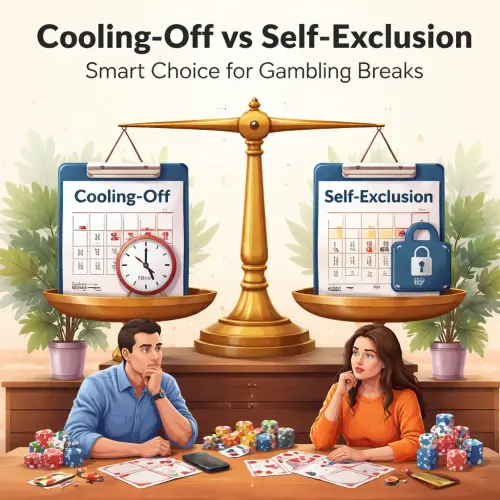
What Readers Should Know About the Cooling‑off vs Self‑Exclusion Choice
I remember sitting at my laptop at 2 a.m., feeling that familiar mix of frustration and adrenaline. I had won, then lost, then chased it, and I knew I needed a break—but I wasn’t sure if I needed a night off or a full reset. That question led me down a rabbit hole of options: cooling‑off vs self‑exclusion. In this guide, I’ll break down both so you can pick the path that works for you.
Why Timing Matters in Gambling Break Options
The length of your break can change everything. Self‑exclusion vs cooling‑off period isn’t just about days versus months—it’s about how much distance you need to break a cycle. Short resets work for mild overspending, while longer blocks help if you’ve struggled repeatedly.
How Online Casinos Handle Both Tools
Most licensed sites offer these features in your account settings. A cooling‑off period usually lets you set a timer (24 hours, 7 days, or up to 6 weeks). Self‑exclusion typically requires contacting support and may block you from all sites under the same license—often for a minimum of 6 months. Knowing the difference helps you avoid accidentally choosing the wrong one.
Cooling‑Off vs Self‑Exclusion: A Practical Comparison Table
To see the gap clearly, here’s a side-by-side look at the key differences.
| Feature | Cooling‑Off | Self‑Exclusion |
|---|---|---|
| Duration | 24 hours to 6 weeks | 6 months to permanent |
| Scope | Usually one account | Often multi-site (same license) |
| Cancellation | Auto-ends; can be immediate | Irreversible until period ends |
| Best for | Impulse resets, single-site habits | Problem gambling, deep patterns |
| Support resources | Optional links | Often includes counselling referrals |
Core Differences Between Gambling Self‑Exclusion Time Limits
The biggest gap? Flexibility. Gambling self‑exclusion time limits are strict because they’re meant as a safeguard—you can’t just flip a switch and return. Cooling‑off is softer; it’s like hitting pause on a remote. Both require honesty with yourself about what you’ll actually do after the clock runs out.
How to Choose the Right Gambling Break for Your Situation
This isn’t a one-size-fits-all decision. Here’s a step-by-step framework I’ve used myself and with friends who ask, “Cooling‑off vs self‑exclusion—which is better?”
Step 1: Assess Your Recent Behavior
Look at your last three sessions. Did you spend more than planned? Did you chase losses? If it happened once or twice, a cooling‑off might be enough. If it’s a pattern, consider self‑exclusion. Keep a quick log—dates, amounts, feelings—to spot trends.
Step 2: Define Your Goal
Ask: What do I want to achieve? A cooling‑off helps you regain composure before a tense chase. Self‑exclusion is for when you need structure to rebuild healthier habits. Write down your goal—maybe “Stop playing for 2 weeks” or “Avoid casinos for a year”—and match the tool to it.
Step 3: Check Site-Specific Rules for Gambling Break Options
Different operators have different policies. Some let you set multi-site cooling‑offs; others don’t. Always read the fine print on gambling break options so you know exactly what happens when the timer ends. For example, many UK-licensed casinos automatically remove bonuses during cooling‑off, but that’s not universal.
Common Mistakes to Avoid When Picking a Break Type
I’ve seen people choose poorly and regret it. Here are the top traps to sidestep.
Going Too Short for a Real Problem
A 24-hour cooling‑off won’t help if you can’t stop after a big loss. If you can’t trust yourself on day 2, you need the longer lock of self‑exclusion vs cooling‑off period.
Skipping Fine Print on Self‑Exclusion
Some programs don’t cover all sites under the same group. You might block one account but still access another. Always confirm the scope—it could ruin the whole point of taking a break.
Ignoring the Mental Prep Needed After the Break
Neither option works if you return the same way. Plan what you’ll do differently after the time off: set deposit limits, use reality checks, or talk to a support service. That’s where real change happens.
Useful Resources
For more detail on responsible gambling tools, check these official sources:
- GambleAware Tools and Advice — comprehensive guide to cooling‑off and self‑exclusion programs.
- National Council on Problem Gambling: Self-Exclusion — state-by-state info on exclusion programs and time limits.
Frequently Asked Questions About Cooling‑off vs Self‑Exclusion
What’s the main difference between cooling‑off and self‑exclusion?
Cooling‑off is a short break (24 hours to 6 weeks) that you can set yourself, while self‑exclusion is a longer ban (6 months+) that usually blocks you from multiple sites under the same license.
Can I cancel a cooling‑off period early?
It depends on the operator. Many sites allow you to cancel cooling‑off immediately, but some require waiting until the set time expires. Always check the specific terms.
Is self‑exclusion reversible?
No—self‑exclusion is typically irreversible until the minimum period (often 6 months) ends. After that, you may need to reapply for access. It’s designed to prevent impulsive returns.
Which is better for a single bad night: cooling‑off or self‑exclusion?
A cooling‑off period is usually better for isolated incidents. It gives you a day or two to cool down, but you can return once you’ve reset mentally.
Does self‑exclusion work across different casinos?
Many licensed operators participate in multi-operator exclusion programs (like GamStop in the UK or state-run programs in the US), but not all. Confirm the scope before signing up.
Can I use both cooling‑off and self‑exclusion at the same time?
Technically yes, but it’s redundant. If you self-exclude, you’re already barred. Cooling‑off would have no extra effect during that period.
How do gambling self‑exclusion time limits vary by country?
UK programs require a minimum 6-month exclusion, while some US states offer 1‑year or 5‑year options. EU countries may have different rules, so check local regulations.
Will I lose my bonuses during a cooling‑off?
Often yes—most sites pause or remove active bonuses during cooling‑off. Read the terms to avoid surprises when you return.
Does self‑exclusion affect my winnings?
No—your existing balance is treated according to the operator’s terms. You can usually withdraw any remaining funds after the exclusion starts, but not gamble during the period.
Can I set a cooling‑off without contacting customer support?
Most sites let you set cooling‑off directly in your account settings. Self‑exclusion often requires a support request or a separate enrollment form.
What happens if I try to log in during cooling‑off?
You’ll be blocked from playing until the timer runs out. Some sites let you view your account but not place bets or deposit.
Is there a limit on how many cooling‑offs I can take?
Not typically—you can use cooling‑off as often as you wish. But if you repeatedly rely on it, that might signal a deeper issue that self‑exclusion could address better.
Does self‑exclusion stop live casino games?
Yes. If you self-exclude from a site that offers live dealer games, you’ll be blocked from all real-money games, including live options.
Can I self-exclude from just one game type?
Some operators allow game-specific limits, but self‑exclusion usually covers all real-money gambling on the site. Cooling‑off may have more flexible options for specific categories.
How do I know if I need self‑exclusion instead of cooling‑off?
If you’ve repeatedly tried shorter breaks and still returned to harmful gambling patterns, self‑exclusion is likely the safer choice. A honest self-assessment or a chat with a support service can help.
Will my account be deleted during self‑exclusion?
No—your account is usually frozen, not deleted. You can re‑access it after the exclusion ends, often with a reactivation request.
Do I need to provide proof for cooling‑off or self‑exclusion?
Cooling‑off typically requires no proof. Self‑exclusion may ask for identification to prevent you from creating new accounts.
Can I set a cooling‑off for someone else?
No—these tools are personal. If you’re concerned about someone else, encourage them to use the tool themselves, or suggest third-party blocking software like Gamban.
Does cooling‑off affect loyalty points?
Some casinos freeze or expire loyalty points during a cooling‑off. Check the terms to see if your points remain intact.
What should I do after my break ends?
Take a moment to evaluate your bankroll habits. Set deposit limits, enable reality checks, and consider speaking with a professional if you still feel anxious about gambling.