

Geo‑blocking: US, UK, France, Netherlands – why your IP is rejected Key Takeaways
You try to access a service based in the US, UK, France, or the Netherlands, and your IP address is instantly rejected.
- Geo‑blocking: US, UK, France, Netherlands – why your IP is rejected often comes down to regional licensing and automated IP screening tools.
- Common triggers include using a known VPN server, a previously flagged data-center IP, or an IP from a country outside the allowed region.
- Proven fixes include switching to a residential proxy, choosing a clean server, or contacting the platform’s support team for whitelisting.
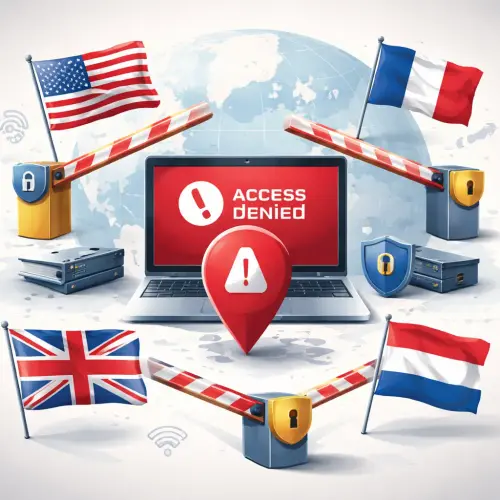
Understanding Why Geo‑blocking: US, UK, France, Netherlands – why your IP is rejected Happens
Geo‑blocking: US, UK, France, Netherlands – why your IP is rejected is a daily reality for millions of internet users. Streaming services, financial platforms, e‑commerce sites, and even news portals enforce regional restrictions to comply with content licensing deals, local regulations, or security protocols.
When your IP is rejected, the system has identified your online location as falling outside the permitted region. This can happen even if you are physically inside the country — especially if you use a VPN or a proxy that the service’s detection engine has flagged.
Common Reasons for IP Rejection in the US, UK, France, and Netherlands
The four countries you mentioned share similar enforcement mechanisms, but each has its own peculiarities:
- Streaming licensing: Services like Netflix, Hulu, BBC iPlayer, and France.tv enforce strict region locks. A VPN IP from a known data center will be blocked immediately.
- Banking and finance: US and UK banks often reject IPs that originate from high‑risk countries or that appear to be routing through anonymizing services.
- Government and news: Dutch and French government portals sometimes block non‑EU IPs for security or data‑protection reasons.
- E‑commerce: Sites like Amazon US or bol.com may restrict pricing or inventory based on your IP region.
Top 4 Proven Fixes to Bypass Geo‑restrictions
If you keep seeing “access denied” or “your IP is rejected,” try these four technical mitigation strategies. They work for most users, including those in the US, UK, France, and Netherlands.
1. Switch to a Residential Proxy or IP
Data‑center IPs are easy to detect. Geo‑blocking: US, UK, France, Netherlands – why your IP is rejected often boils down to the type of IP you are using. Residential proxies are IP addresses assigned by ISPs to real homes. They appear as legitimate local traffic and are far less likely to be flagged.
Many proxy providers offer dedicated residential IPs for specific countries. Choose a provider that allows you to select the exact region (e.g., a London IP for UK access).
2. Change Your VPN Server or Provider
Not all VPNs are equal. Free VPN services often reuse the same IPs across hundreds of users, and those IPs end up on blacklists within days. If your current VPN is blocked, try a premium provider that regularly rotates IPs and offers obfuscation features.
Look for a VPN with multiple servers in the target country. Sometimes simply switching from a US East Coast server to a US West Coast server can resolve the block.
3. Use a Smart DNS or Unlocator Service
For streaming services, a Smart DNS can be more effective than a VPN. Instead of routing all your traffic through a remote server, Smart DNS only intercepts the data that reveals your location. Many streaming‑focused services like Unlocator or Smart DNS Proxy are designed to bypass geo‑blocking: US, UK, France, Netherlands – why your IP is rejected for platforms like Netflix, BBC iPlayer, and Hulu.
Smart DNS services are also less likely to be detected because they don’t change your IP address — they simply reroute specific domain requests.
4. Contact the Platform’s Support Team
If you have a legitimate business or personal need to access a service from a restricted region, reaching out to support can sometimes work. Explain your situation and ask if they offer a whitelisting option or a direct partnership that allows access.
This approach works best for financial platforms, online education sites, or business software. For consumer entertainment services, support teams rarely make exceptions — but it never hurts to ask.
Technical Checklist to Prevent IP Rejection
Before you try any fix, run through this quick checklist to identify the most likely cause:
| Check | What to Look For | Action |
|---|---|---|
| IP type | Is your IP from a data center or a residential ISP? | Switch to a residential proxy. |
| VPN detection | Does the error mention VPN or proxy? | Try obfuscated servers or Smart DNS. |
| IP reputation | Use a blacklist checker online. | Contact your VPN provider or change IP. |
| Regional settings | Have you accidentally chosen the wrong server? | Pick a server physically in the required country. |
Useful Resources
For a deeper dive into IP blacklisting and residential proxies, check out these authoritative sources:
- Cloudflare’s guide to geo‑blocking — explains how geo‑blocking works at the network level.
- ExpressVPN IP lookup tool — check the location and type of your current IP address.
Frequently Asked Questions About Geo‑blocking: US, UK, France, Netherlands – why your IP is rejected
Why does a US service reject my IP even when I am in the US?
Your IP address may still be associated with a VPN or data‑center range. Some services block entire IP blocks from cloud providers, even if you are physically present in the country.
Is geo‑blocking legal in the US and Europe?
Yes, for most private services. However, the EU’s “Geo‑blocking Regulation” prohibits unjustified discrimination based on nationality or residence within the EU, but exceptions exist for copyright and content licensing.
Can I use a free VPN to bypass geo‑blocking?
Free VPNs often have limited servers, slow speeds, and IPs that are already blacklisted. They generally do not work well for bypassing strict geo‑blocking in the US, UK, France, or the Netherlands.
What is the difference between a VPN and a residential proxy?
A VPN routes all your traffic through a remote server (often a data center), while a residential proxy uses an IP assigned by an ISP to a real home. Residential proxies are harder to detect as proxies.
Why does my IP get rejected only on certain websites?
Each website or service uses its own detection methods, blacklists, and licensing agreements. A website in the Netherlands may block IPs from outside the EU, while a US streaming service may specifically target data‑center IPs.
How do streaming services detect my real location?
They use your IP address, DNS queries, browser geolocation APIs, and sometimes even your device’s time zone and language settings to determine your location.
Does a Smart DNS work for all services?
No. Smart DNS works well for many streaming platforms, but may not work for services that use additional detection methods like browser fingerprinting or GPS location (on mobile).
Can my ISP be the reason my IP is rejected?
Indirectly, yes. If your ISP assigns you an IP that was previously used for spam or abuse, that IP may be on blacklists. You can request a new IP from your ISP.
What is a “blacklisted IP range”?
It is a set of IP addresses that have been identified as belonging to VPN providers, proxy services, or known abuse sources. Services block entire ranges to prevent access.
How do I check if my IP is blacklisted?
Use online tools like MXToolbox, WhatIsMyIPAddress, or IPVoid to test your IP against multiple blacklists. If your IP appears, you’ll need to request delisting or switch to a new IP.
Does changing my DNS server help with geo‑blocking?
Changing to a public DNS (like Google or Cloudflare) usually does not bypass geo‑blocking because the service still sees your real IP. Smart DNS services, however, use a different approach.
Why does the Netherlands block some EU IPs?
Some Dutch services block IPs from countries with high fraud rates or from specific cloud providers, even within the EU. Licensing agreements for sports and entertainment also create restrictions.
Can I use a mobile hotspot to bypass geo‑blocking?
Often yes. Mobile carriers assign IPs from residential or mobile ranges that are less likely to be flagged. However, speeds can be inconsistent.
What is obfuscation in a VPN?
Obfuscation disguises VPN traffic as regular HTTPS traffic, making it harder for firewalls and detection systems to identify that you are using a VPN. This helps bypass deep packet inspection.
Does clearing cookies help with geo‑blocking?
Sometimes. If a website uses geolocation data from your browser history, clearing cookies may remove that cached information. It is not a primary fix but worth trying alongside other methods.
Why do French services block non‑French IPs?
French broadcasters and streaming platforms enforce geo‑blocking to comply with copyright laws and licensing deals that limit content to audiences in France (and sometimes francophone Europe).
What is the best residential proxy provider for the UK?
Providers like Bright Data, Oxylabs, and Smartproxy offer dedicated residential IPs in the UK with city‑level targeting. Pricing varies, so compare features based on your use case.
Can I use Tor to bypass geo‑blocking?
Tor is generally not recommended for bypassing geo‑blocking because many services block Tor exit nodes entirely. It also slows down your connection significantly.
Does restarting my router change my IP?
It may, depending on your ISP. Many ISPs use dynamic IP assignment, so restarting your modem can release your current IP and assign a new one. It is worth a try before purchasing new tools.
Why do US banks block EU IPs?
US banks often restrict access from outside the US as a fraud‑prevention measure. They may also need to comply with the Bank Secrecy Act and other federal regulations.