

blackjack strategy chart Key Takeaways
Memorizing and using a blackjack strategy chart is the single most effective way to cut the house edge from roughly 2% down to 0.
- A perfectly played blackjack strategy chart reduces the casino’s mathematical advantage to under 0.5% in most standard games.
- Knowing when to split, double down, and surrender is just as important as your basic hit/stand decisions.
- Print this chart and keep it next to you while playing online or reference it after every hand in a live casino until the moves become automatic.
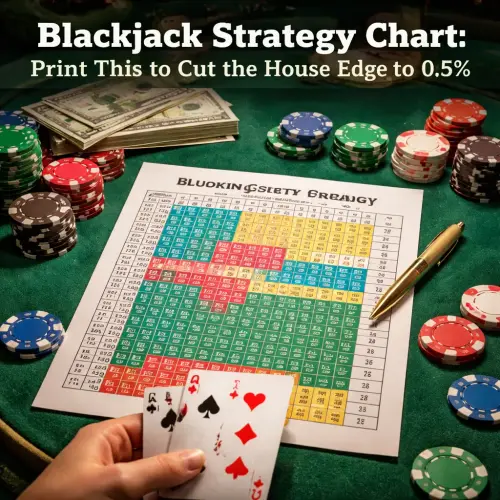
Why a blackjack strategy chart is your best tool to reduce the house edge
Every hand of blackjack presents a decision: hit, stand, double down, split, or surrender. Without a proven system, players rely on gut feeling or superstition, which typically gives the house a 2% to 5% edge. The blackjack strategy chart eliminates guesswork by mapping your exact move based on your hand total and the dealer’s upcard. This mathematically optimized approach—often called basic strategy—brings the house edge down to just 0.5% in a standard six-deck game where the dealer stands on soft 17.
The chart is built from billions of computer simulations. Every cell represents the play that maximizes your long-term expected value. When you follow it perfectly, you are playing blackjack at a nearly break-even level, turning a game of chance into a game of skill.
How to read the blackjack strategy chart
The chart is organized as a grid. The leftmost column shows your hand total, and the top row shows the dealer’s upcard (2 through Ace). Find the intersection of your hand and the dealer’s card, and the cell tells you what to do.
Hard totals vs. soft totals vs. pairs
Hard totals are hands without an Ace or where the Ace counts as 1 to avoid busting. Soft totals include an Ace counted as 11. Pairs are two identical cards like 8-8 or A-A. Each type has its own section on the chart because the strategy differs significantly.
Chart symbols explained
Most charts use letters to indicate the action: H for hit, S for stand, D for double (hit if doubling not allowed), P for split, and R for surrender (if available). When the chart says D, you should double down whenever the casino rules allow; if not, you hit. This subtlety is important—always check the house rules before you sit down.
Printable blackjack strategy chart for hard hands
Below is the simplified strategy for hard totals. Print this section and keep it in your wallet or phone case for quick reference.
| Your Hand | 2 | 3 | 4 | 5 | 6 | 7 | 8 | 9 | 10 | A |
|---|---|---|---|---|---|---|---|---|---|---|
| 17+ | S | S | S | S | S | S | S | S | S | S |
| 16 | S | S | S | S | S | H | H | H | H | H |
| 15 | S | S | S | S | S | H | H | H | H | H |
| 14 | S | S | S | S | S | H | H | H | H | H |
| 13 | S | S | S | S | S | H | H | H | H | H |
| 12 | H | H | S | S | S | H | H | H | H | H |
| 11 | D | D | D | D | D | D | D | D | D | D |
| 10 | D | D | D | D | D | D | D | D | H | H |
| 9 | H | D | D | D | D | H | H | H | H | H |
| 8 or less | H | H | H | H | H | H | H | H | H | H |
Printable blackjack strategy chart for soft hands and pairs
Soft hand strategy
Soft hands (Ace counted as 11) give you flexibility because you cannot bust on one hit. Double down aggressively when the dealer shows a weak upcard (4, 5, or 6).
| Your Hand | 2 | 3 | 4 | 5 | 6 | 7 | 8 | 9 | 10 | A |
|---|---|---|---|---|---|---|---|---|---|---|
| A,9 | S | S | S | S | S | S | S | S | S | S |
| A,8 | S | S | S | S | D | S | S | S | S | S |
| A,7 | D | D | D | D | D | S | S | H | H | H |
| A,6 | H | D | D | D | D | H | H | H | H | H |
| A,5 | H | H | D | D | D | H | H | H | H | H |
| A,4 | H | H | D | D | D | H | H | H | H | H |
| A,3 | H | H | H | D | D | H | H | H | H | H |
| A,2 | H | H | H | D | D | H | H | H | H | H |
Pair splitting strategy
Splitting pairs creates two independent hands, which can double your profit potential but also your risk. Always split Aces and 8s; never split 10s, 5s, or 4s.
| Your Hand | 2 | 3 | 4 | 5 | 6 | 7 | 8 | 9 | 10 | A |
|---|---|---|---|---|---|---|---|---|---|---|
| A,A | P | P | P | P | P | P | P | P | P | P |
| 10,10 | S | S | S | S | S | S | S | S | S | S |
| 9,9 | P | P | P | P | P | S | P | P | S | S |
| 8,8 | P | P | P | P | P | P | P | P | P | P |
| 7,7 | P | P | P | P | P | P | H | H | H | H |
| 6,6 | P | P | P | P | P | H | H | H | H | H |
| 5,5 | D | D | D | D | D | D | D | D | H | H |
| 4,4 | H | H | H | P | P | H | H | H | H | H |
| 3,3 | P | P | P | P | P | P | H | H | H | H |
| 2,2 | P | P | P | P | P | P | H | H | H | H |
Key rule variations that affect the blackjack strategy chart
The chart above assumes standard Las Vegas Strip rules: six decks, dealer stands on soft 17, double after split allowed, blackjack pays 3:2, and surrender is not available. If the game you are playing deviates from these, the house edge changes.
Surrender (late surrender)
When surrender is offered, you can fold your hand and lose only half your bet. Surrender hard 16 against a dealer 9, 10, or Ace, and hard 15 against a dealer 10. This alone shaves about 0.07% off the house edge.
Dealer hits soft 17 (H17)
If the dealer hits on soft 17, the house edge increases by roughly 0.22%. You must adjust the chart: double down more conservatively on soft hands, and stand less often on certain hard totals. For example, with 11 against a dealer Ace, hit instead of double.
Number of decks
Single-deck blackjack offers the lowest house edge (as low as 0.15% with perfect basic strategy), but many casinos limit doubling or pay 6:5 on blackjack. Six- and eight-deck games are the most common and still allow a 0.5% edge when you follow the chart.
Blackjack pays 6:5 vs. 3:2
Do not play any game where blackjack pays 6:5. This single change increases the house edge to over 1.5%, making the blackjack strategy chart much less effective. Always scan the table felt or ask the dealer before sitting down.
Common mistakes that increase the house edge
Even experienced players drift from basic strategy in predictable ways. Avoid these errors to preserve your 0.5% edge.
Taking insurance or even money
Insurance is a side bet that the dealer has blackjack. It has a negative expected value of about 7.5%. Never take it, no matter how strong your hand or how long you have been losing.
Not doubling down when the chart says to
Many players hesitate to double down with a total of 10 or 11 because they fear the dealer might have a 10 underneath. The math is clear: doubling those hands against a dealer 3 through 6 returns more money over time than hitting. Trust the blackjack strategy chart. For a related guide, see Live Dealer vs RNG Games: 5 Key Differences for Blackjack, Roulette and Baccarat.
Standing on 12 against a dealer 2 or 3
Twelve against a dealer 2 or 3 looks scary because you might bust with a 10. However, the dealer’s bust probability with those upcards is high enough that hitting gives you a slight edge. The chart says hit—so hit. For a related guide, see Roulette Inside vs Outside Bets: Surprising Expected Value Difference.
Playing by intuition after a winning streak
Emotional deviations from the chart almost always cost you. The blackjack strategy chart is not a suggestion—it is the result of millions of hands of data. Follow it every time, regardless of how the table feels.
How to practice with the blackjack strategy chart
To drill the chart until it becomes second nature, follow these steps.
Step 1: Use free online blackjack games
Many casino sites offer free play modes. Open the chart on your phone or tablet and play hand after hand, checking every decision. After 200 hands, you will start to remember the most common situations.
Step 2: Focus on the exceptions
Most hands are straightforward: hit until you reach 17, stand on 17 or higher. The tricky decisions are the exceptions: 12 vs. 2, 16 vs. 10, soft 18 vs. 9. Create flashcards for these specific cells.
Step 3: Test yourself without the chart
Once you feel confident, play a session without looking at the chart. Every time you hesitate or guess wrong, mark that hand and review it after the session. Repeat until your error rate drops to zero.
Frequently Asked Questions About the blackjack strategy chart
Useful Resources
For a deeper dive into the mathematics behind basic strategy, visit Wizard of Odds Blackjack Strategy Calculator, which lets you generate a custom chart for any rule set. Another excellent reference is Blackjack Apprenticeship’s strategy charts and training tools, used by professional card counters to practice decision-making under pressure.
Frequently Asked Questions About blackjack strategy chart
Can a blackjack strategy chart really reduce the house edge to 0.5%?
Yes, when you follow the chart perfectly on a standard six-deck game with 3:2 blackjack and dealer stands on soft 17, the house edge drops to approximately 0.5%.
Is a blackjack strategy chart legal to use in casinos?
Yes, printed charts are allowed in most casinos as long as you do not use an electronic device. Some casinos may restrict visible charts at the table, so check with the pit boss.
What is the difference between a basic strategy chart and a blackjack strategy chart ?
They are the same thing. A basic strategy chart is simply the standard blackjack strategy chart that shows the mathematically optimal move for every hand combination.
Should I use a different blackjack strategy chart for single-deck games?
Yes, single-deck strategy has slight differences, especially regarding doubling down and splitting. Use a chart specifically designed for the number of decks in play.
What does ‘D’ mean on a blackjack strategy chart ?
D stands for double down. If the casino allows it, place an additional bet equal to your original bet and receive exactly one more card. If doubling is not allowed, hit instead.
What does ‘P’ mean on a blackjack strategy chart ?
P means split. Split your two cards into two separate hands, place an additional bet equal to your original, and play each hand independently.
What does ‘R’ mean on a blackjack strategy chart ?
R means surrender. You forfeit your hand and lose half your bet. This option is not available at every casino.
Can I win consistently using a blackjack strategy chart ?
No. The chart minimizes the house edge, but the casino still has a statistical advantage. Short-term variance means you will have losing sessions. The chart is for long-term optimization, not guaranteed wins.
Do I need to count cards to use a blackjack strategy chart ?
No. The chart works independently of card counting. Counting cards can add a further edge, but the chart alone is powerful enough to reduce the house edge to 0.5%.
How long does it take to memorize a blackjack strategy chart ?
Most players can memorize the chart in two to three weeks of daily practice, playing 100–200 hands each day. The pairs section takes the longest because it has the most exceptions.
Is the blackjack strategy chart the same for online blackjack?
Yes, if the online game uses standard rules. However, some online variants have different payout structures or side bets that change the optimal strategy. Check the game rules first.
What is the worst mistake new players make with a blackjack strategy chart ?
Standing on 12 against a dealer 2 or 3. Many players fear busting, but hitting that hand reduces the house edge more than standing.
Does the blackjack strategy chart account for the dealer’s hole card?
No, the chart is based solely on your hand and the dealer’s upcard. You never try to guess the hole card; the chart already accounts for the probability of every possible hole card.
Can I use a blackjack strategy chart for Spanish 21 or Blackjack Switch?
No, those games have different rules and paytables. You need a specialized chart designed for each specific variant.
Should I always double down on 11?
Yes, with one exception: if the dealer shows an Ace and the game is H17 (dealer hits soft 17), hit instead of double. In a standard S17 game, always double on 11.
Is it worth printing the blackjack strategy chart on a card?
Absolutely. A laminated card fits in your wallet and lets you check a decision in seconds. It is the cheapest and most effective tool to improve your game.
What is the house edge if I use the chart but make a few mistakes?
Each mistake adds roughly 0.1% to 0.5% to the house edge. A few errors per session can push the edge above 1.5%. Perfection is the goal.
Does the blackjack strategy chart work for high-limit tables?
Yes, the math is the same regardless of bet size. The chart is equally effective at a $5 minimum table or a $500 minimum table.
Can I use a blackjack strategy chart on a mobile app?
Yes, many blackjack training apps include an interactive chart that highlights the correct play as you tap your cards. It is a great way to practice on the go.
Where can I find a free printable blackjack strategy chart ?
Reputable gambling strategy sites and blackjack books offer free printable charts. Look for one that matches your specific game rules (number of decks, dealer stands/hits on soft 17).