

common triggers for account suspension Key Takeaways
Logging into your account only to find it locked or suspended can be frustrating and alarming.
- Incomplete or expired KYC documentation is the leading cause of suspension across banking, crypto, and trading platforms.
- Creating multiple accounts to exploit bonuses or bypass restrictions is a fast track to a permanent ban.
- AML screening flags unusual transaction patterns, and even legitimate activity can trigger a freeze if compliance thresholds are crossed.
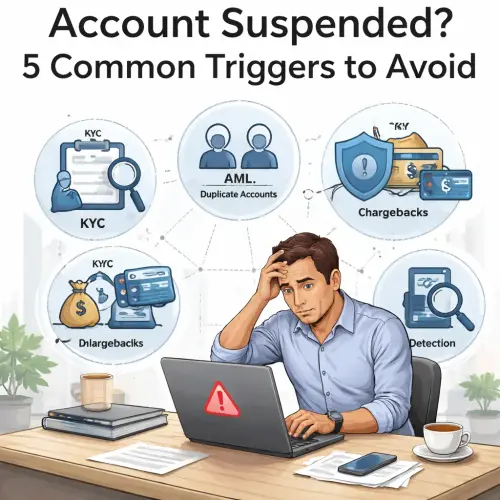
What Are the Most common triggers for account suspension?
Account suspensions happen more often than most users expect. Whether you are using a fintech app, a cryptocurrency exchange, an e-commerce marketplace, or a bank, the underlying reasons usually fall into a handful of categories. Understanding these account suspension triggers can help you avoid the headache of a frozen account and potential loss of access to funds or services. For a related guide, see Account Suspended? 3 Common Triggers (KYC, Duplicate, AML) and How to Avoid Them.
KYC Account Suspension: The Verification Trap
Know Your Customer (KYC) requirements are mandatory for most regulated financial platforms. KYC account suspension typically occurs when documents submitted are expired, blurry, mismatched, or flagged by automated verification systems. Names not matching the government-issued ID, inconsistent addresses, or even a selfie that fails liveness check can trigger a freeze. For a related guide, see Age Verification Id Check Before Withdrawal: 5 Essential Questions Answered Clearly.
To prevent this, always upload clear, color images of valid passports or driver’s licenses. Ensure your legal name matches the name on the account exactly. Some platforms require address proof dated within the last three months—don’t overlook that.
How to Fix a KYC Suspension
Contact the compliance team with corrected documents. Provide both front and back images without glare or cropping. If your name changed due to marriage, include the marriage certificate as supporting evidence. Most platforms resolve KYC issues within 24 to 72 hours if documents are correct.
Duplicate Account Suspension: One Account Per Customer
Creating multiple accounts on the same platform—sometimes accidentally—can lead to duplicate account suspension. Companies enforce one-account-per-user policies to prevent bonus abuse, market manipulation, and identity fraud. Even if you created a second account with a different email or phone number, cross-referencing your name, address, IP address, or device fingerprint will flag the duplicate.
If you need a business account alongside a personal one, most platforms offer a way to request this legitimately. Never create extra accounts to claim multiple sign-up bonuses or bypass trading limits. The risk of permanent banning is high.
Best Practices to Avoid Duplicate Flags
- Use only one email and phone number per platform.
- If you forget login details, always use the “forgot password” option instead of creating a new account.
- Contact support before opening any secondary account, even for legitimate reasons like corporate vs. personal use.
AML Suspension: When Your Transactions Raise Red Flags
Anti-Money Laundering (AML) compliance systems monitor all financial activity for suspicious patterns. AML suspension can be triggered by large or rapid deposits and withdrawals, transactions from high-risk jurisdictions, or structuring deposits to stay below reporting thresholds (e.g., repeatedly sending $9,999 instead of $10,000). Both banks and cryptocurrency exchanges use these systems.
Surprisingly, even legitimate business payments or peer-to-peer lending can look like money laundering to an algorithm. If your account is flagged, you may be asked to provide source-of-funds documentation—payslips, tax returns, invoices, or bank statements proving the money’s origin.
What to Do During an AML Review
Stay calm and cooperate fully. Provide clear evidence of lawful income and transaction purpose. Delays are common, but accounts are usually reinstated once compliance officers manually review the documentation. Never try to circumvent AML checks by breaking up transactions—that worsens the suspicion.
Chargeback Account Suspension: The Merchant’s Worst Nightmare
Chargebacks occur when a customer disputes a transaction with their card issuer or bank. While chargebacks exist to protect consumers, excessive chargeback ratios—even a few per month—can lead to chargeback account suspension from payment processors like Stripe, PayPal, or merchant accounts. Merchants often close accounts that surpass a 1% chargeback rate.
If you run an online business, monitor your chargeback ratio carefully. Provide responsive customer service to resolve disputes before they escalate. Use clear billing descriptors so customers recognize the charge on their statement. For buyers, filing unwarranted chargebacks repeatedly can get your consumer account flagged across multiple platforms.
Inactivity and Policy Violations as Suspension Triggers
Beyond the big four triggers, inactivity for 12–24 months can lead to account dormancy and eventual suspension, especially on trading platforms and digital wallets. Policy violations—such as using a VPN to access geo-restricted content, posting prohibited items on a marketplace, or engaging in abusive customer behavior—also result in suspension.
Reading a platform’s terms of service (those lengthy documents most of us skip) can save you trouble. Set a reminder to log in at least once a quarter if you want to keep an account active but unused.
How to Check Your Account’s Status After Suspension
Most platforms send an email explaining the suspension reason. Check your spam folder. If you receive no email, check the platform’s notification center or transaction history for flags. Contact customer support directly with your account ID and a clear description of the issue.
Document Checklist for Reinstatement
| Trigger | Documents Needed | Typical Resolution Time |
|---|---|---|
| KYC account suspension | Passport or driver’s license, proof of address (utility bill, bank statement) | 24–72 hours |
| Duplicate account suspension | Explanation of why multiple accounts exist, identification for each | 1–5 business days |
| AML suspension | Source of funds (payslips, invoices, tax returns), transaction explanation | 3–14 business days |
| Chargeback account suspension | Proof of delivery or service, customer communication logs | 7–30 days |
Prevention Checklist: Keep Your Account Active
Apply these practices proactively to avoid being caught off guard by the common triggers for account suspension:
- Complete KYC within 24 hours of registration using clear, valid documents.
- Use only one account per platform. Merge duplicates if possible before they are flagged.
- Keep transaction patterns consistent. Avoid rapid, unexplained inflows/outflows.
- Maintain a chargeback ratio below 0.5% if you are a merchant. For buyers, resolve disputes directly with the seller first.
- Log in at least once every three months to prevent inactivity suspension.
- Read the platform’s terms of service thoroughly—especially prohibited activities.
- Use a strong, unique password and enable two-factor authentication to prevent unauthorized access that might trigger security suspensions.
Useful Resources
For deeper guidance on compliance and risk management, review these authoritative sources:
- FATF AML/CFT Compliance FAQ – Official guidance on anti-money laundering standards that financial platforms follow.
- Stripe Guide to Reducing Chargebacks – Practical tips for merchants to prevent chargeback account suspension and maintain a healthy payment processing history.
Frequently Asked Questions About common triggers for account suspension
What should I do first if my account is suspended?
Check your email and the platform’s notification center for the suspension reason. Then contact customer support with your account ID and any requested documents.
How long does a KYC account suspension last?
It typically takes 24 to 72 hours after you submit correct documents. Complex cases may take up to a week.
Can I have two accounts on the same platform legally?
Some platforms allow business and personal accounts if you request permission first. Creating unsolicited duplicates usually leads to duplicate account suspension.
What triggers an AML suspension ?
Large or unusual transactions, rapid deposits and withdrawals, patterns designed to avoid reporting thresholds, and transactions with high-risk regions.
How many chargebacks lead to account closure?
Most processors close merchant accounts that exceed a 1% chargeback-to-transaction ratio. Even 2–3 chargebacks in a month can trigger suspension for new accounts.
Can I appeal an account suspension?
Yes, nearly all platforms have an appeal process. Submit documentation and a written explanation through the official support channel.
Does inactivity alone cause suspension?
Many platforms suspend accounts inactive for 12 months or longer. Some send warning emails before suspension.
What is a “liveness check” in KYC?
It is a biometric verification step where you take a real-time selfie or short video to prove you are physically present, not using a photo or deepfake.
Can using a VPN cause suspension?
Some platforms restrict VPN usage to prevent geo-arbitrage or fraud. Check the terms—using a VPN on a restricted service can lead to suspension.
Are account suspensions permanent?
Not always. Many suspensions are temporary until you complete verification or resolve the flagged issue. Permanent bans usually follow severe or repeated violations.
Why did my crypto exchange suspend my account without warning?
Automated AML or KYC systems flag activity instantly. You may not receive a warning because the algorithm detects high-risk patterns before a human reviews the case.
How can I avoid duplicate account suspension on bonus sites?
Never create extra accounts for bonuses. If you made a mistake, contact support immediately to merge or close the duplicate before detection.
Does a chargeback affect my credit score?
Chargebacks themselves do not directly affect credit scores unless the unpaid debt goes to a collection agency. But they can lead to account closure and blacklisting by payment processors.
What documents prove source of funds for AML review?
Valid documents include recent payslips, tax returns, bank statements showing salary deposits, invoices for freelance work, and notarized gift letters.
Can I get my funds back after a permanent ban?
In most cases, platforms will return funds after identity verification and legal compliance steps, but they may deduct fees or impose withdrawal limits.
What is the difference between suspension and account closure?
Suspension is temporary (you can often reactivate). Closure is permanent, and the account cannot be reopened; any remaining balance is handled per terms.
How do payment processors detect chargeback abuse?
They track chargeback frequency, ratio, and pattern. Filing disputes on every purchase or repeatedly claiming “unauthorized” transactions raises red flags.
Will updating my address trigger KYC re-verification?
On many platforms, yes. A change of address may prompt a new proof-of-address requirement. Update your details before moving to avoid interruption.
Can I use a PO Box for address verification?
Most platforms require a physical residential address. PO Boxes are often rejected for KYC proof-of-address requirements.
What should I do if my appeal is denied?
Request a detailed explanation of why it was denied and ask for a second review by a senior compliance officer. If the issue is a policy violation you disagree with, consider legal advice or filing a formal complaint with a regulator.