

cooling-off Key Takeaways
Taking a cooling-off break is one of the healthiest ways to handle conflict—but only if you do it right.
- A clear, kind statement like “I need 20 minutes to breathe” keeps cooling-off respectful and drama-free.
- Setting a time limit and a check-in plan prevents the break from feeling like abandonment or stonewalling.
- The goal isn’t to win the argument—it’s to return calmer and more connected, which is the heart of healthy conflict resolution .
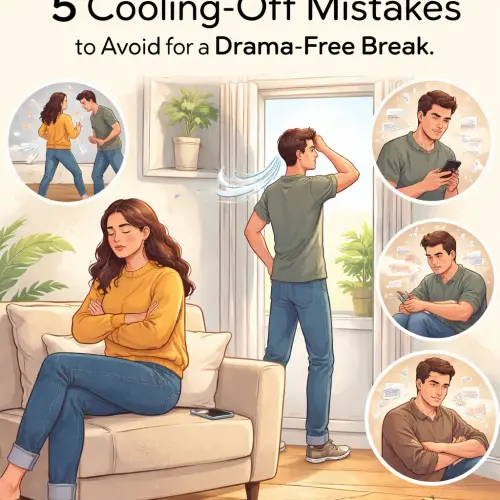
Why a Drama-Free Cooling-Off Break Matters
You’re in the middle of a heated argument. Voices rise. Stomachs knot. Instead of saying something you’ll regret, you mutter, “I need a break,” and walk away. That moment—the way you leave—can be the difference between a repair and a rift.
A well-handled cooling-off pause lowers adrenaline, lets you think clearly, and preserves respect. A messy exit—storming off, giving the silent treatment, or blaming your partner as you go—adds fuel to the fire. The result? What could have been a 20-minute reset turns into a two-day cold war.
The good news is that learning a few simple rules transforms cooling-off from a risky move into a superpower for healthy conflict resolution.
Mistake #1: Leaving Without a Word
One of the most common cooling-off mistakes is simply walking away mid-sentence. Your partner is still talking, you disappear. Suddenly, the person left behind feels dismissed, unimportant, or punished. That’s not a pause—that’s abandonment.
What to do instead
Use a script like: “I’m feeling flooded right now. I need 15 minutes to calm down, then I’ll come back and we can talk.” This small act of communication changes everything. It shows respect, names the need, and promises a return. You’re not running away; you’re taking a strategic breather in your relationship break without drama. For a related guide, see 4 Reality Checks – The Pop-Up That Saves Your Budget.
Mistake #2: Blaming Your Partner When You Call the Break
Phrases like “You’re making me so angry I can’t even think” or “I need space because you’re impossible to talk to” turn a cooling-off into an attack. Blame escalates hurt and makes your partner defensive. It also puts the cause of your emotional state on them, which rarely invites cooperation. For a related guide, see 7 Smart Reasons You Need This Guide (Even If You Think You Don’t).
What to do instead
Focus on your own experience. Say “I’m getting too upset to listen well. I need a time-out.” The shift from “You” to “I” statements keeps the exit calm and unblaming. This small tweak is a cornerstone of healthy conflict resolution because it takes responsibility for your own regulation.
Mistake #3: Disappearing Without a Time Check
You say you need a break, then vanish for two hours. You scroll your phone, take a nap, or go for a drive. Meanwhile, your partner is stuck in uncertainty—waiting, worrying, and often getting angrier by the minute. Without a timeline, the cooling-off feels like punishment, not a reset.
What to do instead
Set a specific time to check back in. It can be as short as 10 minutes or as long as 30, but make it concrete: “Let’s pause for 20 minutes and then meet in the kitchen.” Knowing when the conversation will resume reduces anxiety and builds trust in your relationship break without drama. Use a timer if you have to—it keeps both of you accountable.
Mistake #4: Ruminating and Rehearsing Your Arguments
You’re on your cooling-off break, but you’re not actually cooling down. You’re replaying every hurtful exchange in your head, planning your next comeback, or mentally listing all the ways you’re right. This is the opposite of a reset. You’ll return even more heated than when you left.
What to do instead
Use the break to truly self-soothe. Take slow breaths. Go for a short walk. Splash cold water on your face. Listen to music that calms you. The point isn’t to win the argument later—it’s to lower your stress response so you can listen and problem-solve. This is the core of effective cooling-off and healthy conflict resolution.
Mistake #5: Returning and Picking Up Right Where You Left Off
You come back from the break, sit down, and your first sentence is “Okay, so you said that I never help with the kids, and that’s not true…” You’ve just undone the entire pause. Jumping back into the same argument at the same emotional temperature makes the break pointless.
What to do instead
Reconnect before you re-engage. Start with something soft: “Thank you for giving me that space. I’m ready to listen now. Can you tell me what was most important to you?” Acknowledge the break itself. Re-establish safety. Then, if possible, reframe the conversation with curiosity instead of accusation. A good cooling-off ends not with a bang, but with a bridge back to each other.
Additional Tips for a Successful Cooling-Off
If you’re wondering whether you can prevent arguments altogether, check out this practical guide on arguing less with your partner for broader strategies. Also, the Gottman Institute has excellent resources on the “time-out” technique, which is the clinical name for a structured cooling-off—you can read more on their official blog.
Useful Resources
For more on making conflict pauses work in your relationship, check out these evidence-based guides:
- How to Argue Less With Your Partner – Psychology Today
- The Gottman Time-Out – The Gottman Institute
Frequently Asked Questions About cooling-off
What is a cooling-off break in a relationship?
A cooling-off break is a mutually understood pause during a conflict. Both partners agree to step away for a short, defined time to calm down, then return to talk with a clearer head. It’s a tool for healthy conflict resolution, not a way to punish or avoid each other.
How long should a cooling-off break last?
Experts typically recommend 20 to 30 minutes minimum, because adrenaline peaks around the 15-minute mark. A break can be up to a few hours if needed, but try to check in within 24 hours to avoid stonewalling. The key is to agree on a specific time to reconnect so the break feels safe, not indefinite. For a related guide, see 2 Loss Limits: Avoid the Worst Mistake That Drains Your Bankroll.
What if my partner refuses to honor the cooling-off request?
If they keep following you or insisting you talk immediately, you can say, “I really want to handle this well. Can we please pause for 20 minutes so I can be present with you?” If they still push, calmly repeat your boundary and physically go to another room. This can take practice, but staying firm is part of healthy conflict resolution.
Is cooling-off the same as stonewalling?
No. Stonewalling is a withdrawal that shuts down communication without a plan to return. Cooling-off is intentional, time-limited, and followed by a conversation. The difference lies in the agreement and the check-in.
Can you take a cooling-off break over text or phone?
Yes, if a conversation is getting heated remotely, you can say, “I need to step away for 15 minutes. Let’s text back then.” Avoid disappearing mid-conversation. A clear message keeps the break respectful and still a relationship break without drama.
What should I do during the cooling-off time?
Do something that genuinely lowers your stress: deep breathing, a short walk, stretching, listening to music, or journaling your feelings (not your rebuttals). Avoid replaying the argument or checking your phone for messages—that keeps you activated.
How do I initiate a cooling-off without sounding cold?
Use a warm but clear tone: “I care about this conversation, but I’m feeling too upset to hear you well. Let’s take 15 minutes and come back.” Framing it as an act of care makes it a cooling-off move, not a rejection.
What if my partner uses the break to vent to friends and get more upset?
Encourage each other to use the break for self-regulation, not venting. You can gently say, “I’m going to use this time to breathe. I’d love for you to do something that calms you too.” If they still vent, you can only control your own response.
Can cooling-off breaks work for arguments with kids or teenagers?
Absolutely. Model the same process: “I’m getting frustrated right now. I’m going to take a 10-minute break, and then we’ll talk.” This teaches emotional regulation and is a powerful form of healthy conflict resolution for the whole family.
What if we can’t agree on how long the break should be?
Compromise. If one person wants 20 minutes and the other wants 40, try 30. The important thing is the agreement itself, which builds trust. You can always negotiate next time.
Is it okay to take a cooling-off break every time we disagree?
No. If you take a break every time things get uncomfortable, you risk avoiding conflict altogether. Use cooling-off only when emotions are high enough that you can’t listen well. For everyday disagreements, staying engaged and practicing calm communication is healthier.
How do I reconnect after a cooling-off break?
Start with appreciation: “Thank you for giving me that space.” Then gently invite the conversation: “I’m ready to talk now. Can you share what was most important to you?” Avoid jumping straight into your own defense.
Can cooling-off help with work conflicts or with friends?
Yes, the same principle applies. In a work email, you can write, “I’d like to pause this discussion and pick it up tomorrow morning.” With a friend, say, “Let’s take a breather and talk after I walk my dog.”
What if I can’t calm down during the break?
If 20 minutes isn’t enough, take a longer break, but communicate that. Say, “I need more time. Can we talk in an hour instead?” The key is not to disappear—keep checking in so the other person feels included.
Are there cultural differences in how cooling-off is perceived?
Yes, some cultures value direct, immediate conflict resolution, while others see pauses as respectful. Talk with your partner about how you each view breaks. Being curious about each other’s background is part of healthy conflict resolution.
Can I use cooling-off if I’m the one who feels attacked?
Absolutely. If you feel attacked, you can say, “I’m hearing you, but I’m feeling defensive right now. I need a few minutes to take in what you said so I can respond better.” That’s a mature cooling-off request.
What if my partner says they need a break but I feel abandoned?
It’s normal to feel left behind. Tell them calmly: “I’m okay with a break, but can we agree on a time to check in?” This turns your anxiety into a request for structure, which both of you can follow.
Should we stop an activity (like dinner or a movie) for a cooling-off?
If emotions are high, yes. Pausing a movie or a meal is better than fuming through it and snapping later. You can always come back to it once you’ve both reset.
Is cooling-off a sign of weakness in a relationship?
No, it’s a sign of emotional intelligence. Recognizing when you’re too activated to communicate well—and doing something about it—is a strength. It’s a core skill for healthy conflict resolution.
How do I teach my kids to use cooling-off?
Model it yourself. Say, “Mommy needs a quiet minute to calm down.” Then create a “calm-down corner” with stuffed animals or books. When they use it, praise them: “I’m proud of you for taking a break.” Children learn best by watching.