

Withdrawal processing times Key Takeaways
For supplier payments, vendor settlements, or payroll with amounts above $5,000, use a bank wire.
- The key difference in withdrawal processing times between e-wallets (as fast as 24 hours) and bank wires (3–5 business days) is driven by how each system moves and verifies funds.
- E-wallets offer faster access for smaller, frequent withdrawals, while bank wires are better suited for large sums.
- Your choice should factor in fees, security thresholds, and whether your recipient supports instant e-wallet transfers.
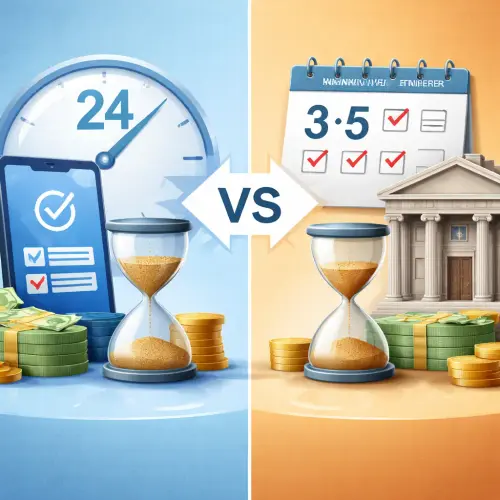
Comparing Withdrawal Processing Times: 24h E-Wallet vs 3–5 Day Bank Wire
The most practical way to decide is to look side by side at how each method works. Below is a direct comparison of the two common withdrawal methods.
| Comparison Factor | 24-Hour E-Wallet | 3–5 Day Bank Wire |
|---|---|---|
| Withdrawal processing times | Typically 24 hours (often same-day for verified accounts) | 3 to 5 business days (weekends/holidays add delay) |
| Transaction limits | Often capped at $5,000–$10,000 per transfer | High limits, often up to $100,000+ |
| Typical fees | Low or zero for standard transfers | $15–$50 per wire (domestic); higher for international |
| Receiver requirements | Must have an account with the same e-wallet provider | Standard bank account (routing/account numbers) |
| Security and reversibility | Fast but limited fraud protection; reversible within provider window | Higher security with SWIFT/tracking; irreversible once sent |
| Best for | Smaller, faster payouts; frequent withdrawals | Large sums; one-time transfers; compliance-heavy scenarios |
Pros and Cons of 24-Hour E-Wallet for Withdrawal Processing Times
E-wallets like PayPal, Skrill, or Wise have become popular for their speed. Here is what to consider before choosing them for your withdrawal processing times needs.
Advantages of E-Wallet Withdrawals
- Speed: Most e-wallet withdrawals process within 24 hours, and many are instant once the sender releases funds.
- Lower fees: Many e-wallet providers charge no fee for receiving or transferring funds internally.
- Convenience: You can hold multiple currencies and access funds from a mobile app without visiting a bank.
- Partial withdrawals: You can often request smaller amounts without penalty, unlike wires which have fixed costs.
Disadvantages of E-Wallet Withdrawals
- Withdrawal limits: E-wallets often cap daily or monthly withdrawals, which can be a problem for large sums.
- Receiver dependency: Both sender and receiver must use the same e-wallet provider for instant transfers.
- Fraud risk: Faster transfers mean less time for fraud detection; unauthorized transactions can be harder to reverse after 48 hours.
Pros and Cons of 3–5 Day Bank Wire for Withdrawal Processing Times
Bank wires remain the standard for high-value and official transactions. Here is how they compare on withdrawal processing times and overall reliability.
Advantages of Bank Wire Withdrawals
- High limits: No practical caps for most personal or business accounts (limits set by bank, not wire system).
- Security: SWIFT and wire networks offer strong tracking and are nearly impossible to reverse without legal action.
- Universal acceptance: Any bank account can receive a wire, anywhere in the world.
- Audit trail: Ideal for business accounts, tax purposes, and compliance requirements.
Disadvantages of Bank Wire Withdrawals
- Slow processing times: Even domestic wires take 1–2 business days; international wires often take 3–5 business days.
- High fees: Banks charge between $15 and $50 per wire, plus intermediary bank charges for international transfers.
- No partial option: Wires are all-or-nothing; you cannot send a portion of a larger amount.
- Weekend delays: Wires only process on business days, meaning a Friday request may not arrive until Wednesday.
Recommended Use Cases by User Type
The best choice depends on your specific situation. Here are practical recommendations based on common user profiles.
Freelancers and Remote Workers
If you receive frequent payments from international clients, use an e-wallet. The 24-hour turnaround reduces cash flow gaps. Keep a bank wire option for quarterly tax payments or large lump-sum projects. For a related guide, see Cash-out in Sports Betting: 3 Smart Situations to Take Profit.
Business Owners and Payroll Managers
For supplier payments, vendor settlements, or payroll with amounts above $5,000, use a bank wire. The higher limit and audit trail improve compliance. Use e-wallets for reimbursements or small expense payouts to employees.
Cryptocurrency and Trading Platform Users
When cashing out profits, choose e-wallet for quick access to reinvestment funds. Use bank wire for large profit transfers (over $10,000) to minimize security risks and ensure proper tax documentation.
Consumers Sending Money to Family
For regular remittances under $2,000, e-wallet is cheaper and faster. For one-time large gifts, especially cross-border, bank wire offers better exchange rates and lower overall fees at high amounts.
How to Choose the Right Withdrawal Method
Selecting between these two options comes down to three key decision points.
Step 1: Evaluate Your Frequency and Amount
If you withdraw weekly or daily, e-wallet saves time and fees. If you withdraw monthly or infrequently, bank wire may be more cost-effective per transaction.
Step 2: Check Receiver Capabilities
Does the recipient have an e-wallet account? If not, e-wallet is not an option. For bank wire, ensure you have correct routing and SWIFT details.
Step 3: Compare Total Fees for Your Amount
For a $500 withdrawal, an e-wallet fee of $0 vs a $25 wire fee makes the decision easy. For a $50,000 withdrawal, a $50 wire fee is negligible compared to the security and limit benefits.
Optimization Tips for Faster Withdrawal Processing Times
Whichever method you choose, these steps can help speed up your withdrawal processing times.
- Verify your account early: Complete identity verification (KYC) before your first withdrawal to avoid delays.
- Use the same provider: Stick to one e-wallet or bank for all withdrawals to pre-fill recipient details.
- Initiate early in the day: Request withdrawals before 10 AM local time to capture same-day processing windows.
- Avoid weekends and holidays: Bank wires initiated on Friday may not process until Tuesday. E-wallet requests made on weekends may queue until Monday.
- Double-check recipient details: A single typo in a bank account number can cause a 2–5 day reprocessing delay.
Common Troubleshooting Issues with Withdrawals
Even with the best planning, problems can occur. Here are quick fixes for common delays.
E-Wallet Withdrawal Shows “Pending” for Days
First, check if the sender has completed their verification. If yes, contact the e-wallet support team. Often, the hold is a manual security review that can be resolved with a quick call.
Bank Wire Has Not Arrived After 5 Business Days
Contact your bank immediately. Provide the SWIFT or wire reference number. The bank can trace the transfer and identify if it is stuck at an intermediary bank.
Withdrawal Limit Exceeded Error
Either split the amount into multiple transfers (e-wallet) or request a temporary limit increase (bank wire). Many banks can raise limits instantly for a single transaction.
Useful Resources
To further compare online payment methods and fees, visit NerdWallet’s guide to wire transfers for detailed fee breakdowns. For e-wallet comparisons, Investopedia’s analysis of PayPal vs Skrill provides an unbiased look at features and limits.
Conclusion: Choosing between an e-wallet and a bank wire ultimately depends on your need for speed, the amount you are transferring, and your comfort with each system’s security. E-wallets win on withdrawal processing times for smaller, frequent withdrawals, while bank wires remain the gold standard for large, secure transfers. Evaluate your specific use case and use the optimization tips above to minimize delays. For a related guide, see Martingale, Fibonacci, Labouchere Simulation: Why All 3 Lose.
Frequently Asked Questions About Withdrawal processing times
What is the fastest withdrawal method: e-wallet or bank wire?
E-wallet is typically faster, with processing times of 24 hours or less, compared to bank wires which take 3–5 business days.
Do weekends affect withdrawal processing times ?
Yes. Bank wires only process on business days, so a Friday wire may not arrive until Tuesday. E-wallet transfers may also delay if the provider’s clearing system is offline.
Can e-wallet withdrawals be instant?
Some e-wallet providers offer instant transfers between users of the same platform, but cross-border or external transfers typically take up to 24 hours.
Which withdrawal method is safer for large amounts?
Bank wires are generally considered more secure for large sums because of SWIFT tracking, irreversible transfers, and bank-level fraud protection.
Why do bank wires take 3–5 days?
Bank wires involve multiple intermediary banks and clearing houses, each adding verification steps, especially for international transfers.
Are e-wallet fees lower than bank wire fees?
Generally yes. E-wallet fees are often $0–$3, while bank wire fees range from $15 to $50 per transaction.
Can I withdraw money directly from an e-wallet to my bank account?
Yes, most e-wallets allow transfers to your linked bank account, but this adds 1–3 days to the overall withdrawal time.
What is the maximum withdrawal limit for an e-wallet?
Limits vary by provider and account level. Typical daily limits range from $2,500 to $10,000 for verified accounts.
Do banks charge extra for international wire transfers?
Yes. International wires often incur fees from the sending bank, intermediary banks, and the receiving bank, totaling $30–$60.
Can I cancel a pending e-wallet withdrawal?
Yes, most e-wallet providers allow you to cancel a pending transaction from your account dashboard if it has not been fully processed.
What is SWIFT and why does it slow down bank wires?
SWIFT is a messaging network banks use to verify transfers. Each communication step between banks adds processing time, especially for cross-border payments.
Are there any free withdrawal methods?
Many e-wallet providers offer free standard transfers between users. Some banks offer one free wire per month for premium account holders.
How does KYC verification affect withdrawal processing times ?
Unverified accounts face longer holds. Completing KYC (identity verification) before the first withdrawal reduces processing time to standard windows.
Can I use both e-wallet and bank wire for the same withdrawal?
No, you must choose one method per transaction. However, you can split a large amount into two separate withdrawals using different methods.
What happens if a bank wire is sent to the wrong account?
Contact your bank immediately. Wires can be recalled, but it is a multi-step process and may take days. Accuracy of recipient details is critical.
Do e-wallets charge currency conversion fees?
Yes, most e-wallets apply a 2–4% fee on currency conversion, which can be higher than bank exchange rates.
Why is my e-wallet withdrawal pending after 24 hours?
Possible reasons: manual security review, verification not completed, or the sender’s account has insufficient funds. Contact support for clarification.
Is there a way to speed up a bank wire?
Some banks offer expedited wire services for an additional fee, reducing domestic transfer time to 1 business day.
What is an e-wallet number and how do I use it?
An e-wallet number (like your PayPal email or Skrill ID) is how recipients send you funds. You share this instead of bank details.
Can I schedule a future withdrawal with bank wire?
Yes, many banking platforms allow you to schedule a wire transfer for a future date, which can help if you want the money to arrive on a specific day.